

Strategy
CPG Leaders Are Ready for AI. They Just Need a Clear Place to Start.
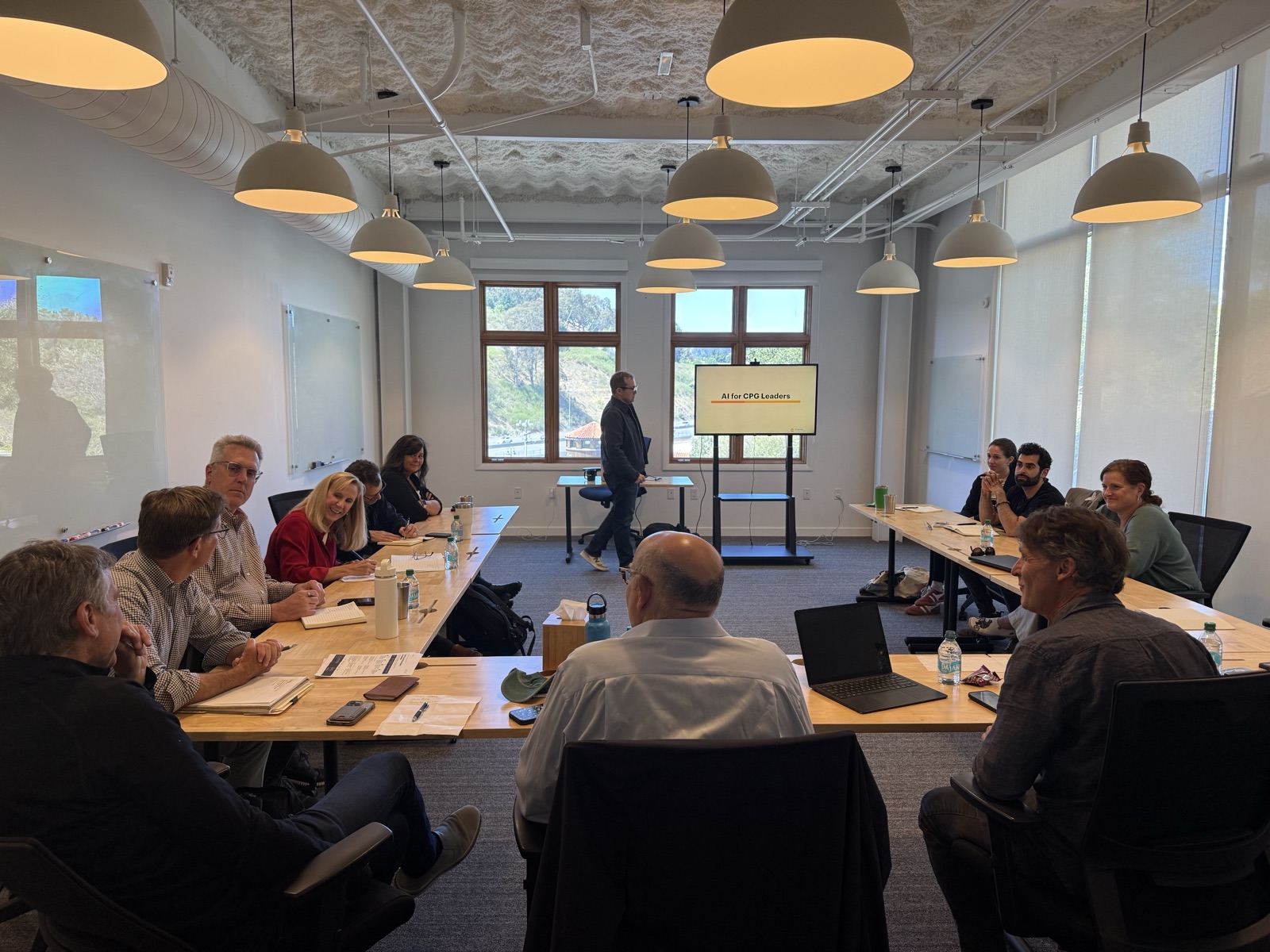
Blair Kellison, who serves on the boards of several mission-driven Northern California CPG companies, had been hearing the same concern from leaders: AI will reshape how their businesses operate, but few know where to begin. I was seeing the same pattern through our work at Telos Labs, so I brought in Jeff Eyet, who teaches AI, strategy, and entrepreneurship at Berkeley Haas. A few weeks later, we had a dozen CPG leaders in a room in Mill Valley, representing companies including Straus Family Creamery, Lotus Foods, Costeaux French Bakery, Kuli Kuli Foods, and The Hatcheri, ready to move the conversation from AI hype to practical action. Within the first few minutes, it became clear that nobody in the room needed to be convinced that AI mattered. The question was practical: where could they begin without distracting their teams, creating another disconnected pilot, or investing in technology before they understood the problem?
The tension was familiar to me. I spent years building technology alongside financial institutions, and I now see similar challenges in our work at Telos Labs. Transformation rarely stalls because leaders do not care. It stalls because the opportunity feels too broad, teams are stretched, and nobody has turned the ambition into a manageable first action.
I want to share what we learned from this session, because it cuts against the version of this story you usually hear: that leaders are behind, leaders need to catch up, or that leaders are hesitant to implement AI. That narrative did not match what I saw in this room. These were sharp, experienced operators who understood AI adoption perfectly well as a concept.
What they lacked was a credible next step, and a way to talk about that next step within their leadership team.
Don't miss the next working session
Sign up for our newsletter to get notified about upcoming events, plus practical advice for putting AI to work in your operations.
Here’s what nine CPG leaders told us, and what I think it means for anyone at the beginning of figuring out what to do about AI in their organization.
Finance and reporting are top of mind
Every single participant identified a specific, practical AI opportunity for their own business by the end of the session. When we asked where they wanted to apply AI first, the answer was clear.
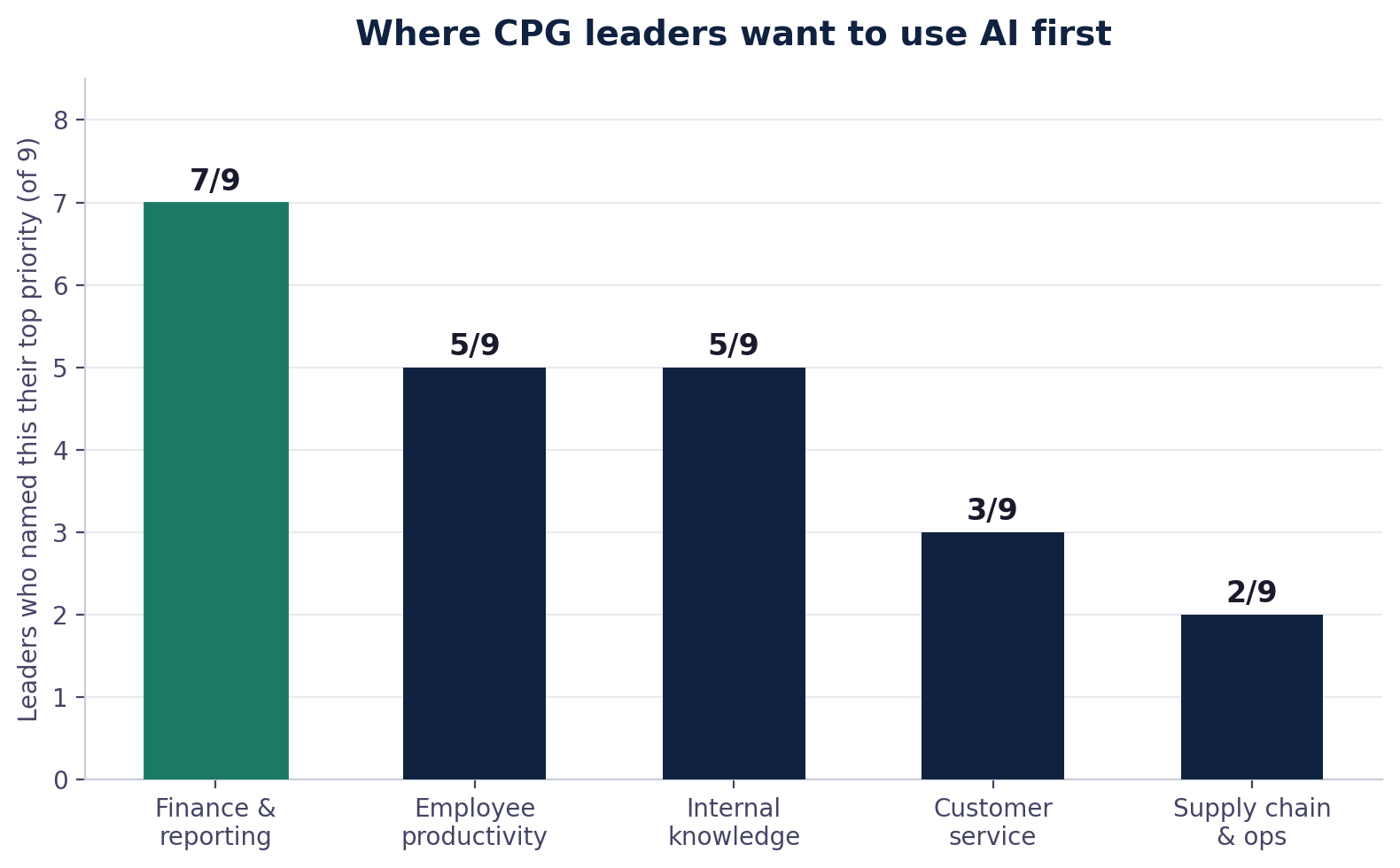
Finance and reporting won by a wide margin: seven of nine leaders named it their top priority. Employee productivity and internal knowledge tied for second at five votes each. Customer service and supply chain trailed.
The result made sense. Many teams still pull data from multiple systems, reconcile spreadsheets, explain margin and inventory variances, and rebuild similar reports each month. The work is essential but repetitive, and often depends on a few people who know where everything lives.
I have a clear opinion about why finance and reporting won. I believe it’s because finance is the one function in most CPG companies where the data is already structured, the owner is already identified, and the outcome is measurable. This is the kind of low ambiguity, high visibility use case that builds organizational trust in AI before you ask anyone to touch something messier, like supply chain forecasting or customer-facing workflows.
For many mid-market companies, finance and reporting may be one of the most practical places to start, not because it is the most exciting use case, but because the workflow, owner, and definition of success are usually easier to see. Not because every company is the same, but because the leaders in that room who started somewhere else, for example customer service, were also the ones who reported the most stalled AI initiatives.
Leadership alignment is the biggest barrier
Here’s the finding that actually changed how I think about this work.
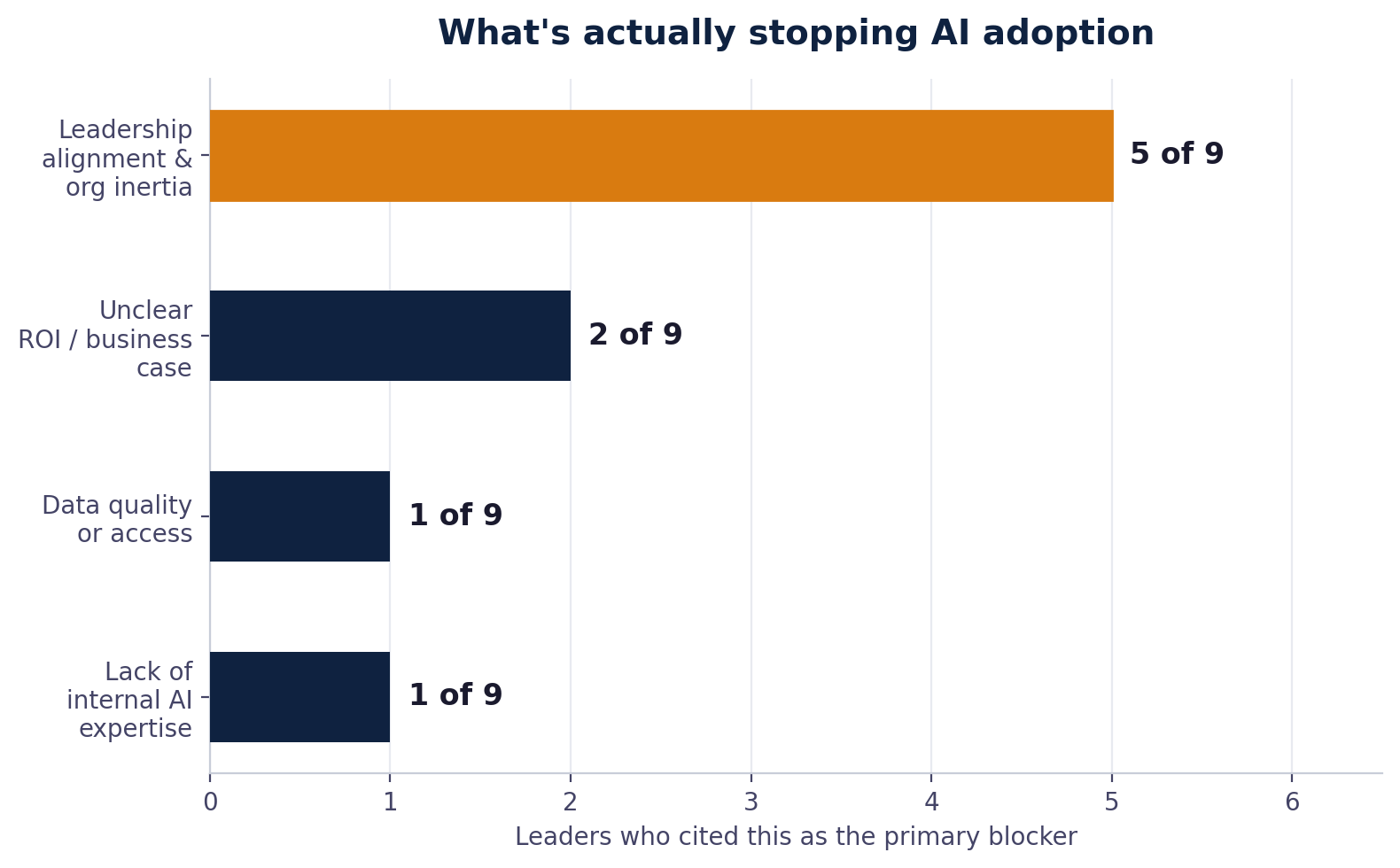
We asked what was actually stopping AI adoption at their companies. Five of nine leaders pointed to the same root cause: leadership alignment and organizational inertia. Not data quality. Not a lack of in-house AI talent. Not unclear ROI, although that came up too. The dominant answer was some version of “my own organization cannot move.”
One leader described it almost exactly like this: senior executives understand AI exists, but don’t understand it well enough to make a clear first step, so nothing gets decided. Another described the trap of going down a rabbit hole exploring every possible AI application without ever setting a clear objective, which produces a lot of activity but zero outcomes.
I do not think this reflects a lack of urgency. It is the reality of running a company. Leadership teams are balancing growth, margins, customer commitments, supply chain challenges, and daily operations. AI matters, but without a clear objective it quickly becomes one more important initiative competing for attention.
For many CPG companies, the immediate barrier is not whether the technology exists. It is whether the leadership team can agree on one problem, give someone authority to address it, and define what success looks like.
The problem is that nobody in your organization has been given the authority, the budget, and the deadline to make one decision and live with it. Buying better software won’t fix that. Naming an owner and a deadline will.
Capturing institutional knowledge, and learning to spot AI hype
When we finished the session, we asked participants what they could do now that they weren’t able to do before attending the session.
The two strongest gains were a four stage framework for combining AI with human oversight, and a sharper sense of how to surface and use institutional knowledge that currently exists only in senior people’s heads.
That second one deserves attention on its own. In a CPG company, the person who knows why a particular SKU underperforms in a particular region, or why a vendor relationship works the way it does, usually carries that knowledge personally rather than having it captured anywhere. With AI, there’s now a clear mechanism for capturing tacit expertise before someone retires or leaves, instead of just hoping the next person figures it out the hard way.
The weakest reported gain was feeling better equipped to evaluate AI claims without falling for hype. I take that as an honest signal about general AI knowledge rather than a failure of the session. Most CPG leaders are now flooded with vendor pitches that all promise transformation and rarely show their actual mechanism. Learning to tell the difference between a real capability and a confident demo is a skill, and it takes more than one afternoon to build.
Where I think CPG leaders should start
Based on everything we learned in that session, here’s the sequence I recommend if you’re early in this process and trying to figure out a credible first move.
1. Start with a workflow you already know well. For many leaders in the room, that was finance and reporting. In your company, it may be sales operations, customer service, internal knowledge, or another repetitive process with a clear owner and measurable outcome.
2. Name one owner with authority, and give them a specific deadline. The leaders who reported the most progress weren’t the ones with the biggest budgets. They were the ones who had assigned a single accountable person instead of a committee. We suggest a timeline of 30-45 days.
3. Answer six questions before you spend a dollar on a vendor. If you can’t answer all six clearly, you’re not ready to evaluate vendors yet, and any vendor who tells you otherwise is selling you something that won’t actually solve a problem:
- What workflow are you improving?
- Who owns it?
- What outcome should change?
- What data do you actually have access to?
- What is the smallest version of a pilot that would teach you something real?
- What organizational changes will this require if it works?
4. Treat institutional knowledge capture as a parallel track, not an afterthought. The expertise sitting in your senior team’s heads is a depreciating asset. Every year you wait to capture it is a year closer to losing it permanently.
Not sure where to start?
Book a discovery call and we'll help you make the first move. Get a clear path forward and measurable outcomes in 3 weeks.
I left the session more optimistic than I entered it. The leaders in the room did not need to be convinced that AI was important. They were looking for a responsible way to get started, move beyond curiosity, and take action without overwhelming their teams or committing to an ambitious roadmap before learning what worked.
Living in Sonoma County, I am constantly reminded of how many remarkable, mission-driven CPG brands have been built in this region. I look forward to continuing to deepen our work in the space through Telos Labs, helping these companies turn AI interest into practical, measurable progress.
Frequently asked questions
More posts in Strategy
Why AI Initiatives Stall: 3 Organizational Gaps and How to Close Them
Most AI initiatives stall for organizational reasons, not technical ones. The three gaps that cause it, and how leadership can close them.

Jul 17, 2026
Easy to Start, Hard to Stop: The Token Economics That Decide Whether an AI SaaS Survives
For an LLM-dependent SaaS, token economics are a survival question. How routing and evals move cost onto an axis you actually control.

Jul 16, 2026
Five Questions to Ask Before You Approve an AI Project
Before you sign off on an AI vendor, agency, or software purchase, five questions surface the cost risks the demo hides.
Jul 15, 2026