

Build, buy, or kill.
Decided.
A decision process that shows what each credible option will cost, with real vendor pricing, and leaves you a sequenced plan for the path that wins.
Get the right decision before you commit a year of your team and six figures of spend to the wrong path.
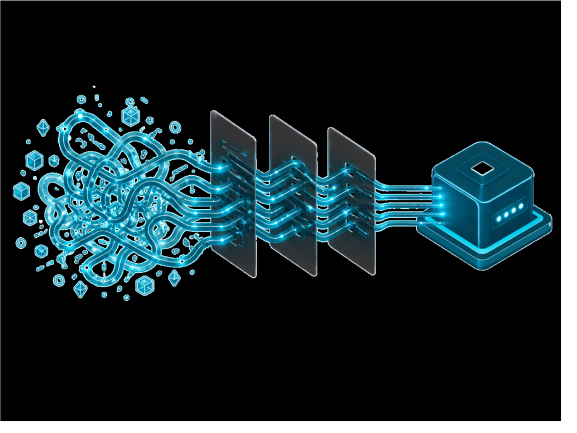
You don't need to start over. You need someone who understands the whole picture.
You have capable people, working systems, and data you trust. The next decision crosses too many boundaries for one owner.
The Strategic Assessment brings those decisions together and gives your team a clear path forward.
- Product requirements and workflows
- The applications you already run
- Build, buy, extend, or leave alone
- Data and integrations
- Application platform and hosting
- Quality and security once it is live
- Your team or a partner
- Long-term cost to operate
Fragmented Foundations
Built at different times, by different teams. They operate in isolation, not as a unified whole.
Compounding Complexity
Every fix adds more complexity. The stack gets harder to understand, not easier.
Decision Gridlock
Too many options. No clear way to choose. Rebuild, buy, or extend all feel risky.
The challenge isn't options. It's knowing what's right.
The bottlenecks we see over and over.
These aren't edge cases. They're where most mid-size teams lose another quarter.
Build vs. buy, undecided for 9 months.
Every vendor pitch looks plausible. Every internal proposal looks expensive. Nobody can make the call stick.
Your CRM (Salesforce) bill keeps climbing, and no one can explain why.
You're being told to "consolidate" or "rebuild." Both are expensive. No one can tell you which is actually right.
A CTO who needs judgment, not hands.
You don't need another contractor. You need someone who's shipped this before and will tell you the truth.
No CTO, and no plan to hire one.
You want technology that meets your clients' bar for quality without building an engineering organization to get there.
Sized to the decision you're making.
- Build versus buy
- Consolidate versus continue
- Several products and existing systems
- More than one technical owner
Not a deck. A decision.
Everything you need to commit with confidence or walk away with clarity.
The credible options, researched in proportion to the decision
Build, migrate, or consolidate. Each path includes real vendor pricing and what it will actually cost over time.
What each vendor will actually cost and the risks
Feature gaps. Lock-in risks. Not a generic comparison.
The hidden costs everyone misses
Migration effort, retraining, integration rebuild, and internal disruption, quantified before you commit.
A plan ready for your team to start on, with the first phase scoped
So you can execute, or take it to another team, with clarity and leverage.
The steps we take to go from kickoff to decision.
Understand
Interviews with the people who own the outcome, a walk through how the work actually runs, and a read of the plans and systems that already exist.
Inspect
The systems, code, integrations, data, and costs that the decision depends on. Fixes that can be made safely will ship as pull requests while we work.
Set the requirements
What the product or decision has to do, which parts are clearly yours to build, and the criteria for everything else.
Investigate the options
Build, buy, extend, application platform, and hosting, researched in proportion to the decision.
Decide with the owners
Recommendations are tested in working sessions with the people who will live with them.
Leave the plan
Sequence, costs, owners, decision gates, and the first phase scoped. Your team can run it with us, alone, or with someone else.
Recommendations your team can check. Principles we build to.
- Every recommendation rests on something checkable: a file, a configuration, a query, a bill, or what someone on your team told us.
- Technical observations go to the people who own the systems first, for accuracy and context, before they go to leadership.
- The current approach gets argued for as seriously as any change.
- Confirmed prices and estimates are clearly marked.
- Recommendations are tested in working sessions before the plan is written.
- The plan is written to be executed without us.
- 01 Enterprise grade outward, simplicity inward.
- 02 A quality line every change passes.
- 03 No lock-in on AI models.
- 04 Do not build what is not needed.
- 05 Sequence for speed and lower risk.
- 06 Tools that make the team better at its work, not order-takers for an AI.
Real decisions.
Every assessment ends with a written decision and a sequenced plan.
The client was being pushed toward Salesforce consolidation. Our analysis showed it would actually increase cost.
We identified a lower-cost build path with equivalent functionality and gave them the plan to execute it.
A growth-stage agency with a 14-month internal build and three pilots that never made it out of staging.
We retired what wasn't working, picked the one workflow that compounds, and scoped the first two weeks of real work.
There is no strategy deck for how your business actually runs.
Dev shops
They start building before knowing if they should.
No vendor analysis. No cost modeling. You end up committing before understanding the decision.
Strategy consultants
You get slides.
Months of analysis, a 60-page report, and no one who can build the thing they recommended.
Telos
We give you the decision and the plan to execute it.
The people who make the recommendation are the people who can inspect the code, ship the fix, and lead the build. Senior judgment with engineers, product, and design behind it.
What happens when the answer is build?
Your team runs it
Alone, or with someone else. The plan is written to be executed without us.
You continue with Telos
Two forms, either or both:
Direction, a standing decision cadence, architecture and code review, product decisions.
Sized to the plan, and scoped separately from the assessment.
One bounded decision. When it prevents one wrong technology decision, it pays for itself immediately.
Questions we hear before every engagement.

In a technology stalemate? Tell us where you're stuck.
We'll tell you how to move forward. No pitch. No commitment.